Alignoralia
Spark File
Spark File
Couldn't load pickup availability
- 📩 Digital file available after purchase
- 📚 Long-term availability
- 🔒 Secure checkout
- 🗓️ Content updated in 2026
Self-paced learning overview
1. Problem Statement — When Programs Need a Thoughtful Structure
After studying fundamental Java structures and creating small algorithms, learners encounter the need to organize code into more complex programming models. Using numerous methods and variables without clearly defined responsibilities can make a program harder to read and modify. Working with multiple objects introduces questions about how their states are stored and how they interact. Additional challenges arise when using collections, handling errors, and creating classes with shared behavior. Studying these topics requires a structured explanation of object-oriented principles and their application in educational examples.
2. Solution — From Individual Classes to Connected Program Models
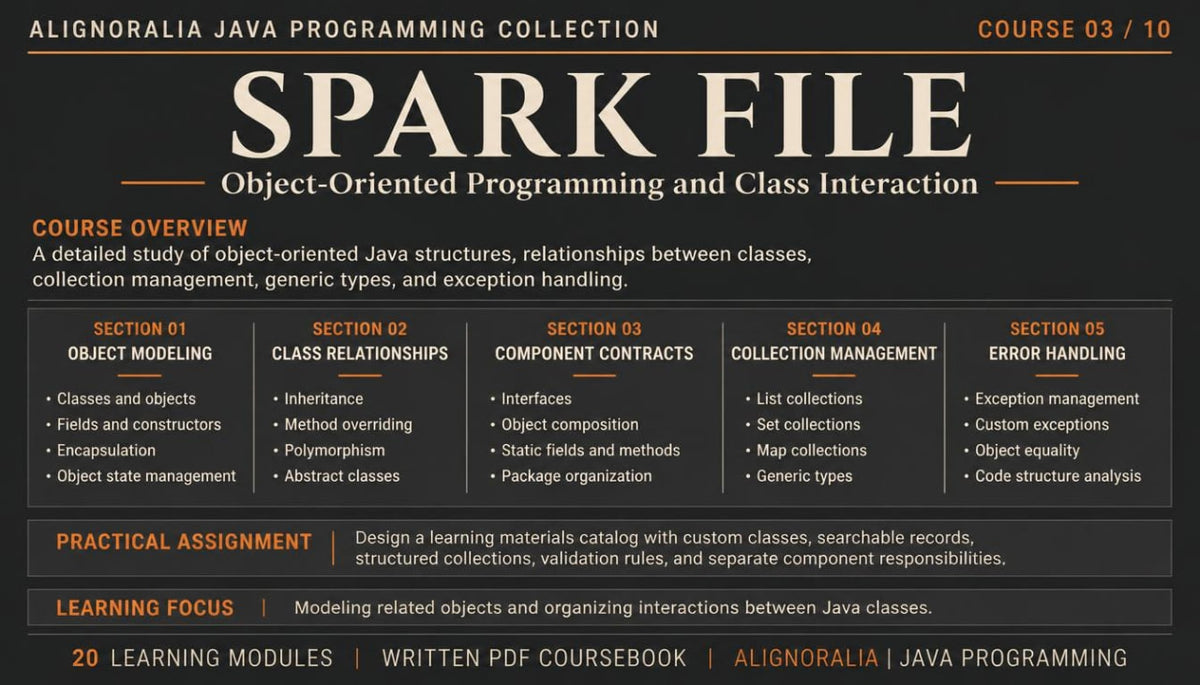
Spark File provides a structured study of Java object-oriented principles through examples of class and object interaction. The learning modules examine encapsulation, inheritance, polymorphism, and interfaces used to describe component behavior. Separate sections cover collections, generic types, and fundamental exception-handling mechanisms. Practical exercises encourage learners to examine class structures, review method behavior, and analyze approaches to information storage. The concluding assignment brings the covered concepts together in a small programming model for organizing and processing records.
3. What's Inside — Course Modules
Module 1: Object-Oriented Code Architecture
Explore the principles of distributing data and behavior between classes in a Java program.
Module 2: Classes and Object Modeling
Learn how to define classes with fields, methods, and constructors representing individual entities.
Module 3: Encapsulation and State Management
Examine visibility modifiers, internal data protection, and methods for managing object state.
Module 4: Constructors and Initialization
Explore constructor overloading, initial parameter handling, and object creation with defined states.
Module 5: Static Fields and Methods
Study the differences between class members and instance members and the rules governing static structures.
Module 6: Inheritance and Class Hierarchies
Learn how to create derived classes and reuse shared characteristics and behavior.
Module 7: Polymorphism and Method Overriding
Examine overridden method calls and the selection of implementations based on actual object types.
Module 8: Abstract Classes
Explore abstract base classes and the definition of shared requirements for derived structures.
Module 9: Interfaces and Programming Contracts
Learn how interfaces describe common behavior across different classes.
Module 10: Composition and Object Interaction
Examine classes that use other objects to carry out separate responsibilities.
Module 11: List and Set Collections
Study storing, adding, removing, and iterating through elements in lists and sets.
Module 12: Map Collections
Learn how to organize key-value pairs and retrieve records using specified keys.
Module 13: Generic Types
Explore type parameters used to create structures and methods that work with different data types.
Module 14: Exception Handling
Study try, catch, and finally statements for managing exceptional situations during code execution.
Module 15: Creating Custom Exceptions
Explore defining separate exception types to describe errors within an educational programming model.
Module 16: Object Comparison
Examine the differences between references, logical object equality, and the use of equals and hashCode.
Module 17: Package Organization and Code Structure
Learn how to group related classes and organize program components according to their responsibilities.
Module 18: Practical Assignment — Learning Materials Catalog
Create a catalog model with learning-material classes, record collections, information searching, and input validation.
Module 19: Program Structure Analysis
Explore approaches to identifying repeated code, unnecessary dependencies, and incorrectly distributed responsibilities.
Module 20: Final Topic Review
Complete exercises covering classes, inheritance, interfaces, collections, and exception handling.
4. Who Is This For?
✅ This course is suitable if you:
- Already understand fundamental Java syntax.
- Are familiar with variables, conditional statements, loops, and methods.
- Have introductory knowledge of classes and objects.
- Want to study object-oriented programming in greater detail.
- Are interested in inheritance, polymorphism, and interfaces.
- Would like to explore collections for organizing data.
- Want to examine interactions between multiple classes.
- Prefer written learning materials supported by code examples.
- Plan to complete object-modeling exercises independently.
- Want to develop a deeper understanding of Java program structure.
❌ This course may not suit you if you:
- Have not yet studied variables, loops, methods, and fundamental Java structures.
- Need an introduction to programming without previous preparation.
- Are looking for advanced materials on distributed systems and network communication.
- Expect detailed coverage of complex concurrent computations.
- Prefer individual instructor-led sessions.
- Need a large ready-made application rather than educational examples and exercises.
5. What You'll Learn
Spark File covers specific principles and practical approaches to organizing Java code.
- Object-Oriented Modeling: Creating classes that represent data and programming behavior.
- Class Structure: Defining fields, methods, and constructors.
- Encapsulation: Managing data visibility and creating methods that control object state.
- Object Initialization: Working with constructors that accept different parameter combinations.
- Static Structures: Understanding the differences between class-level and instance-level characteristics.
- Inheritance: Building class hierarchies and reusing shared behavior.
- Polymorphism: Calling methods through shared types and examining behavior across implementations.
- Abstract Classes: Describing base structures with partially defined behavior.
- Interfaces: Defining contracts for different programming components.
- Composition: Combining objects to perform related tasks.
- Lists: Adding, retrieving, and removing collection elements.
- Sets: Organizing collections of distinct values.
- Key-Value Structures: Using Map collections to store and retrieve records.
- Generic Types: Working with typed collections and parameterized structures.
- Exception Handling: Using exception-handling statements to respond to execution errors.
- Custom Exceptions: Creating separate classes that describe violations of program rules.
- Object Comparison: Defining logical equality between instances.
- Package Structure: Grouping related classes according to their responsibilities.
- Code Analysis: Examining dependencies, repeated structures, and component interactions.
- Practical Modeling: Constructing a small learning-material management model.
6. Refund Terms
Spark File has a 14-day refund period, subject to the published refund policy of the Alignoralia store.
Before purchasing, we recommend reviewing the conditions governing refunds for digital educational materials, the request submission procedure, and the provisions concerning materials already delivered.
7. Certificates & Credentials
Upon completing Spark File, learners receive an Alignoralia PDF certificate documenting their study of Java file handling and text processing.
Do I need previous programming experience to study Alignoralia courses?
Do I need previous programming experience to study Alignoralia courses?
The Alignoralia collection covers different stages of learning Java. Introductory materials explain fundamental syntax and programming principles, while subsequent courses explore more detailed technical topics. Before choosing a course, we recommend reviewing its description, module outline, and practical exercises.
What format do the learning materials use?
What format do the learning materials use?
Alignoralia courses are presented as written PDF coursebooks. The materials contain topic-based sections, explanations of programming structures, code examples, and exercises for independent study. This format allows learners to revisit specific subjects during their studies.
Can I study the materials at my own pace?
Can I study the materials at my own pace?
Yes. The written format allows you to organize your own study sessions, review explanations, and spend additional time on individual exercises when needed. You can plan your studies around your schedule and previous knowledge.
Share