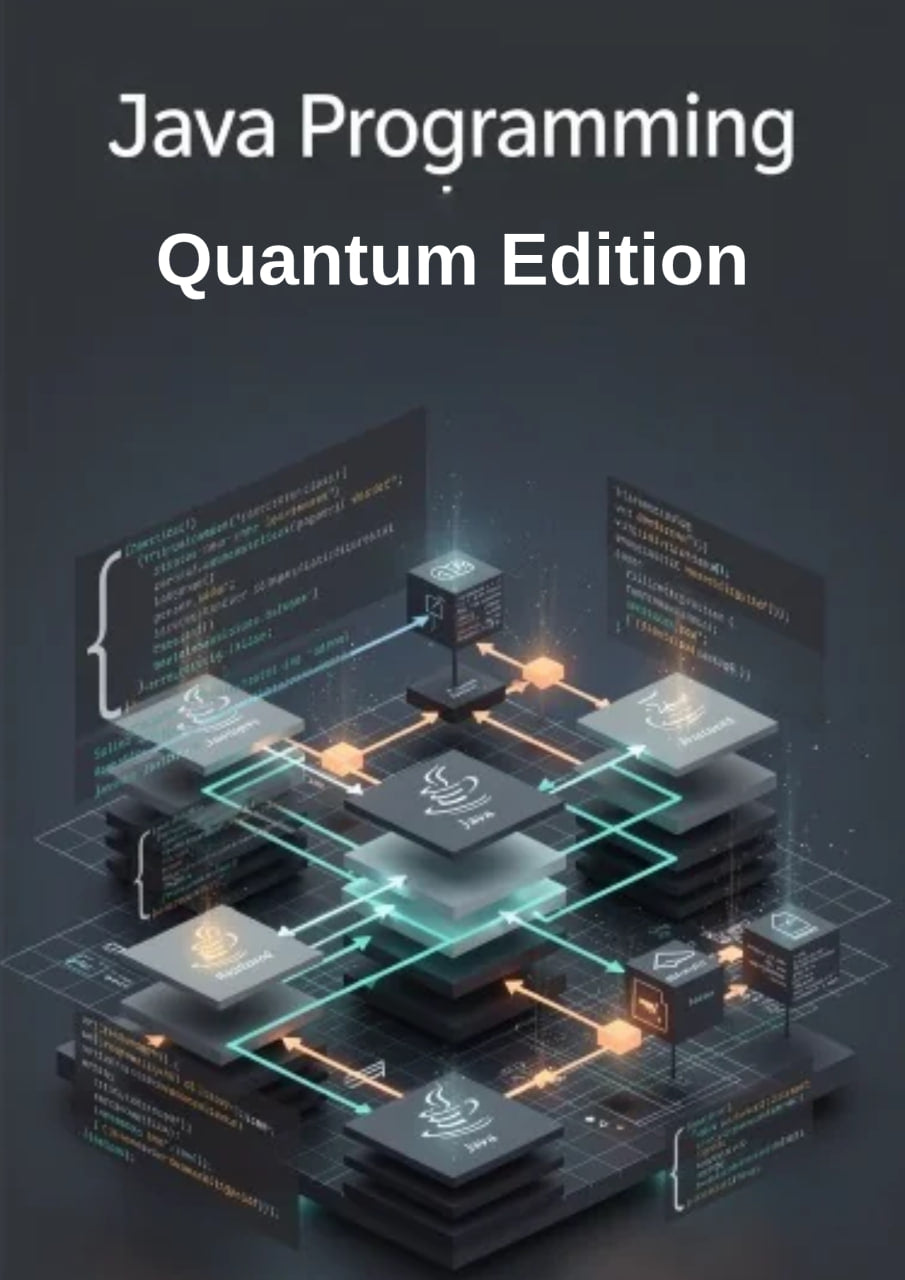
Alignoralia
Quantum Edition
Quantum Edition
Couldn't load pickup availability
- 📩 Digital file available after purchase
- 📚 Long-term availability
- 🔒 Secure checkout
- 🗓️ Content updated in 2026
Self-paced learning overview
1. Problem Statement — When Every System Component Influences Another
Developing complex Java systems requires individual programming components to interact according to defined rules and a shared architecture. As the number of modules increases, managing dependencies, transferring information, coordinating asynchronous processes, and maintaining data consistency become more challenging. Changes within one component may affect other parts of the system, particularly when they share resources or exchange messages. Error handling, system observation, performance evaluation, and testing organization also require careful attention. Studying these architectures involves understanding the relationships between programming logic, data persistence, concurrent operations, and component lifecycle management.
2. Solution — A Connected Architecture for Interacting Processes
Quantum Edition provides a comprehensive examination of Java system architecture through the structured study of components, their contracts, and interaction mechanisms. The learning modules cover application layer design, message processing, asynchronous coordination, transactional operations, and error management. Separate sections explain performance evaluation, diagnostic information organization, and preparing components for future changes. Practical exercises invite learners to analyze architectural decisions, compare information-processing approaches, and examine system behavior under different conditions. The concluding project combines component interaction, record persistence, asynchronous tasks, operation validation, and Java application monitoring.
3. What's Inside — Course Modules
Module 1: Architecture of Complex Java Systems
Explore principles for organizing multi-component applications and understanding relationships between their functional sections.
Module 2: Architectural Layers and Responsibility Boundaries
Examine the separation of request processing, business logic, and data persistence components.
Module 3: Domain Modeling
Learn how classes and interfaces represent domain entities, their states, and interaction rules.
Module 4: Designing Component Contracts
Explore message formats, operation parameters, and result communication rules.
Module 5: Dependency Management
Examine composition and dependency injection for organizing relationships between application modules.
Module 6: Modular Structure and Logic Isolation
Learn how to separate program components according to their responsibilities and interaction rules.
Module 7: Distributed Processing Architecture
Explore interactions between independently operating components that exchange information through messages.
Module 8: Synchronous and Asynchronous Communication
Examine differences between waiting for operation results and executing independent tasks.
Module 9: Events and Message Processing
Learn how to represent application events and coordinate component responses to incoming messages.
Module 10: Task Queues and Process Coordination
Explore queue organization, task distribution, and processing sequence management.
Module 11: Data Consistency Across Components
Examine approaches to maintaining coherent information states during related operations.
Module 12: Transaction Boundaries
Learn how to define operation groups that require coordinated commits or rollbacks.
Module 13: Operation Idempotency
Explore handlers designed to prevent unwanted repeated changes when identical requests are processed again.
Module 14: Retry Handling and Recovery
Examine retry coordination, interrupted operations, and recovery after execution failures.
Module 15: Asynchronous Process State Management
Learn how to track task stages, execution results, and termination conditions.
Module 16: Concurrent Information Processing
Explore synchronization, concurrent collections, and shared resource management.
Module 17: Resource Boundaries and Workload Management
Examine controls for concurrent operation counts, memory usage, and queue sizes.
Module 18: Algorithm Optimization
Learn how to compare algorithmic complexity and identify causes of excessive resource consumption.
Module 19: Performance Diagnostics
Explore execution-time measurements, latency analysis, and resource-intensive code identification.
Module 20: Application Event Logging
Examine structured logs for analyzing requests, errors, and execution states.
Module 21: Metrics and System Observation
Learn how to define component metrics and analyze changes in application behavior.
Module 22: Defensive Mechanism Evaluation
Explore data validation, permission separation, and sensitive information management.
Module 23: Integration Testing
Examine interactions between persistence components, request handlers, and asynchronous execution mechanisms.
Module 24: Failure Scenario Testing
Learn how to simulate delays, invalid messages, interrupted operations, and unavailable components.
Module 25: Managing Architectural Changes
Explore documenting decisions, modifying component contracts, and maintaining compatibility between component versions.
Module 26: Application Lifecycle Organization
Examine resource initialization, service startup, state management, and controlled module termination.
Module 27: Documenting Programming Decisions
Learn how to describe system structures, component interactions, and error-handling rules.
Module 28: Practical Project — Integrated Records Management System
Create an educational Java system with separate components for request processing, data persistence, asynchronous tasks, and event logging.
Module 29: Educational Project Architecture Review
Examine component dependencies, transaction boundaries, error handling, and resource usage.
Module 30: Final Integrated Assignment
Combine architectural design, asynchronous operations, data validation, testing, and diagnostics in a comprehensive educational assignment.
4. Who Is This For?
✅ This course is suitable if you:
- Already have a strong understanding of Java and object-oriented programming.
- Are familiar with modular code organization.
- Understand multithreading and asynchronous processing.
- Have experience with databases and transactions.
- Are familiar with client-server communication.
- Want to explore multi-component system architecture.
- Are interested in event and message processing.
- Would like to study distributed operation coordination.
- Want to examine performance diagnostics and evaluation methods.
- Plan to analyze application resilience during unexpected conditions.
- Are interested in architectural contracts and dependency management.
- Prefer written materials with technical examples and diagrams.
- Want to work independently on an integrated educational project.
❌ This course may not suit you if you:
- Are just beginning to study Java.
- Have not yet studied classes, objects, and interfaces.
- Lack introductory knowledge of multithreaded programming.
- Are unfamiliar with fundamental data management principles.
- Need introductory programming syntax explanations.
- Are looking solely for small algorithm exercises.
- Expect a course focused only on graphical interfaces.
- Prefer individual instructor-led sessions.
- Need a ready-made commercial system rather than an educational architectural model.
5. What You'll Learn
- Java system architecture.
- Modular application design.
- Contracts and dependencies.
- Distributed processing.
- Asynchronous operations.
- Queues and messaging.
- Transactions and data consistency.
- Idempotency and recovery.
- Resource management.
- Performance analysis.
- Logging and metrics.
- Defensive mechanisms.
- Integration testing.
- Architecture documentation.
6. Refund Terms
Quantum Edition has a 14-day refund period, subject to the published refund policy of the Alignoralia store.
Before placing an order, we recommend reviewing the conditions governing refunds for digital educational materials, the request submission procedure, and the provisions concerning files already received.
7.Certificates & Credentials
Upon completing Quantum Edition, learners receive an Alignoralia PDF certificate documenting their completion of the advanced Java application design and architecture course.
Do I need previous programming experience to study Alignoralia courses?
Do I need previous programming experience to study Alignoralia courses?
The Alignoralia collection covers different stages of learning Java. Introductory materials explain fundamental syntax and programming principles, while subsequent courses explore more detailed technical topics. Before choosing a course, we recommend reviewing its description, module outline, and practical exercises.
What format do the learning materials use?
What format do the learning materials use?
Alignoralia courses are presented as written PDF coursebooks. The materials contain topic-based sections, explanations of programming structures, code examples, and exercises for independent study. This format allows learners to revisit specific subjects during their studies.
Can I study the materials at my own pace?
Can I study the materials at my own pace?
Yes. The written format allows you to organize your own study sessions, review explanations, and spend additional time on individual exercises when needed. You can plan your studies around your schedule and previous knowledge.
Share