Alignoralia
Echo Edition
Echo Edition
Couldn't load pickup availability
- 📩 Digital file available after purchase
- 📚 Long-term availability
- 🔒 Secure checkout
- 🗓️ Content updated in 2026
Self-paced learning overview
1. Problem Statement — When Information Must Remain Between Application Sessions
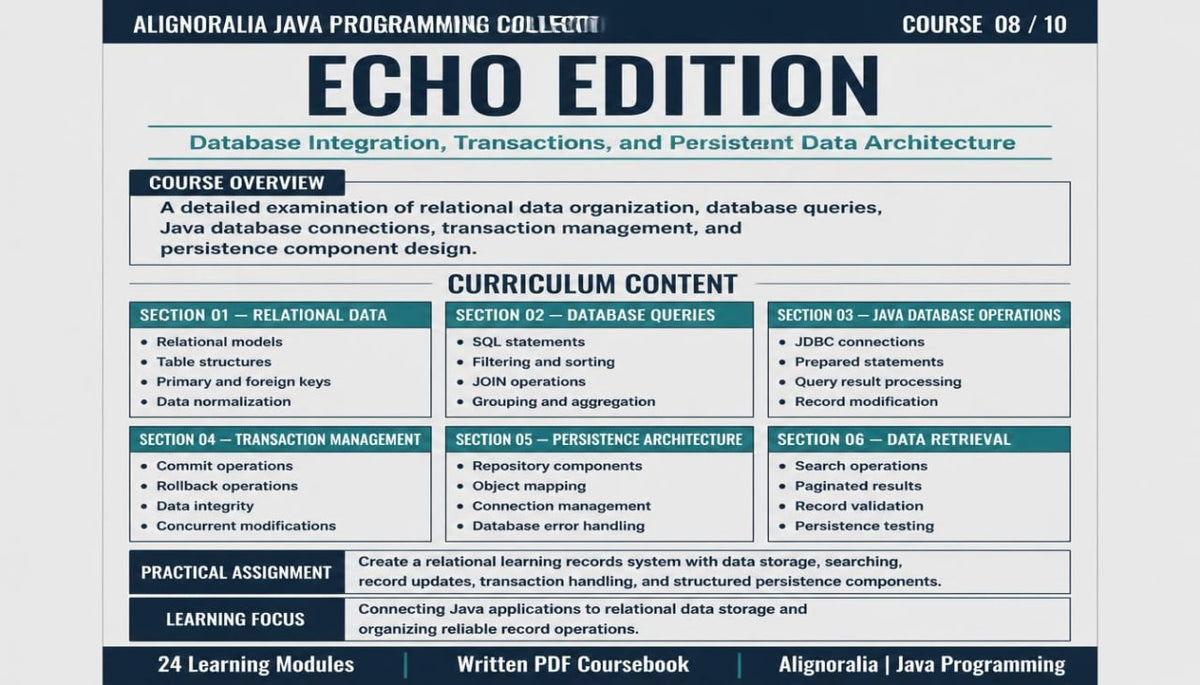
After studying Java network communication, learners encounter the need to organize information storage across different application components. Keeping data only in application memory does not meet the requirements of tasks where records must remain after program execution ends. Database integration introduces questions about table design, relationships between records, and the correct execution of reading and updating operations. Additional challenges arise when handling simultaneous requests, managing errors, and maintaining information consistency. Building such applications requires an understanding of databases, transactions, and information persistence components.
2. Solution — From Individual Records to Organized Data Systems
Echo Edition provides a structured examination of data persistence and information processing mechanisms in Java applications. The learning modules cover relational structures, database queries, connection management, and the organization of read and write operations. Separate sections explain transaction handling, data validation, error management, and responsibility distribution between application components. Practical exercises invite learners to analyze table structures, examine query behavior, and compare approaches to organizing information storage. The concluding educational project combines database operations, application logic, and request handling within a structured Java application.
3. What's Inside — Course Modules
Module 1: Data Persistence Architecture
Explore persistent information storage principles and their role in Java applications.
Module 2: The Relational Data Model
Examine tables, columns, rows, and relationships between record collections.
Module 3: Database Table Design
Learn how to define table structures according to the characteristics of stored information.
Module 4: Primary and Foreign Keys
Explore identifiers and relationships used to organize connected records.
Module 5: Data Normalization
Examine principles for distributing information between tables to reduce unwanted duplication.
Module 6: SQL Query Fundamentals
Study statements for retrieving, inserting, modifying, and deleting records.
Module 7: Information Filtering and Sorting
Learn how to construct queries with selection conditions and result ordering.
Module 8: Joining Related Tables
Explore JOIN operations for retrieving information from multiple related tables.
Module 9: Grouping and Aggregate Operations
Examine counting, grouping, and summarizing values within datasets.
Module 10: Connecting Java to a Database
Learn how JDBC establishes database connections and executes queries.
Module 11: Prepared Statements
Explore PreparedStatement for passing parameters and executing parameterized operations.
Module 12: Processing Query Results
Examine ResultSet and the conversion of retrieved values into Java objects.
Module 13: Inserting and Updating Records
Learn how to implement operations for creating, modifying, and deleting information.
Module 14: Database Connection Management
Explore connection lifecycles, resource cleanup, and database operation organization.
Module 15: Transactions and Data Integrity
Examine grouping operations into transactions and mechanisms for committing or rolling back changes.
Module 16: Concurrent Data Modifications
Explore simultaneous record updates and principles for managing concurrent operations.
Module 17: Database Error Handling
Learn how to analyze query errors, constraint violations, and unsuccessful persistence operations.
Module 18: Data Persistence Components
Examine separate classes for retrieving, storing, and updating records.
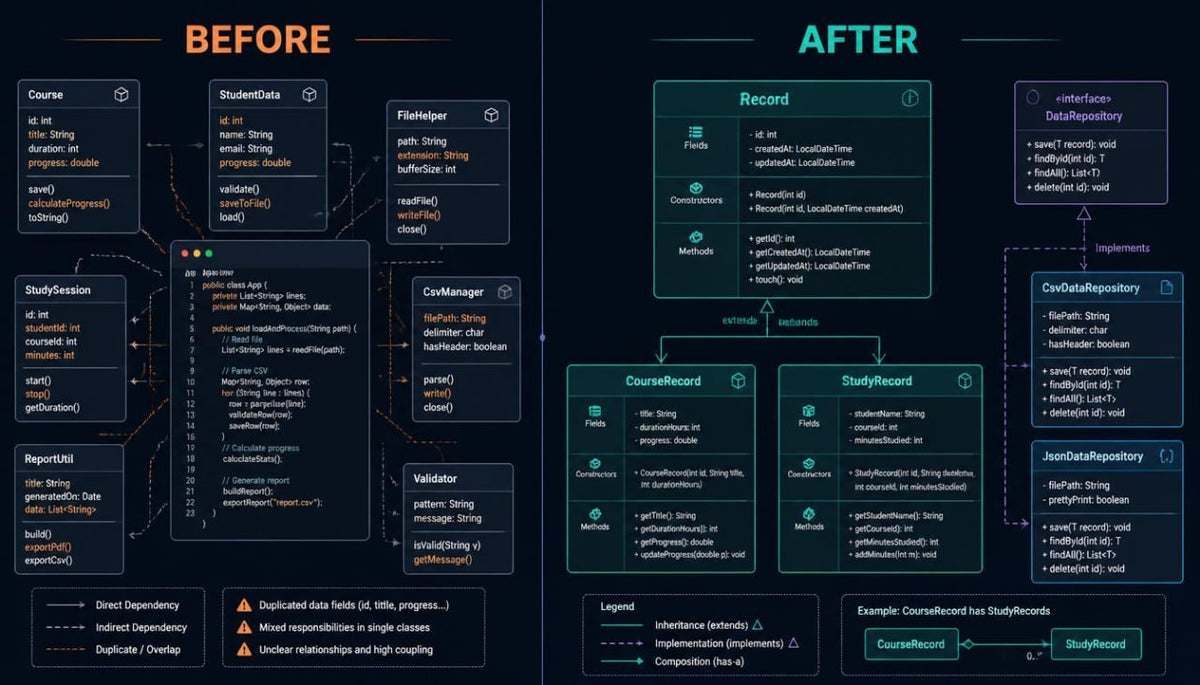
Module 19: The Repository Pattern
Explore organizing persistence components through interfaces and separate implementations.
Module 20: Object-to-Record Mapping
Learn how to map Java object fields to database table columns.
Module 21: Searching and Paginated Data Retrieval
Examine result size restrictions, sorting, and retrieving sections of larger record collections.
Module 22: Testing Persistence Operations
Explore test scenarios involving record insertion, modification, deletion, and subsequent retrieval.
Module 23: Practical Project — Learning Records Management System
Create an educational Java application for storing, searching, editing, and grouping records within a relational structure.
Module 24: Final Data Architecture Review
Combine queries, transactions, persistence components, and data validation in an integrated educational assignment.
4. Who Is This For?
✅ This course is suitable if you:
- Already understand object-oriented Java programming.
- Are familiar with modular code organization.
- Have experience working with classes, interfaces, and collections.
- Understand fundamental exception-handling concepts.
- Want to examine Java database integration.
- Are interested in relational structures and SQL queries.
- Would like to study record storage and update mechanisms.
- Want to explore transactions and information consistency.
- Plan to develop applications with separate persistence components.
- Are interested in testing data storage operations.
- Prefer written educational materials with code examples.
❌ This course may not suit you if you:
- Are just beginning to study Java.
- Have not yet studied classes, methods, and interfaces.
- Need introductory explanations of programming syntax.
- Are looking solely for graphical interface development.
- Expect detailed coverage of server hardware administration.
- Need advanced study of distributed databases.
- Prefer individual instructor-led sessions.
- Expect a large ready-made information system rather than an educational project.
5. What You'll Learn
- Relational databases.
- Database table design.
- SQL queries and JOIN operations.
- JDBC connections.
- Parameterized queries.
- Result processing.
- Transactions.
- Connection management.
- Repository components.
- Object mapping.
- Data validation.
- Persistence testing.
6. Refund Terms
Echo Edition has a 14-day refund period, subject to the published refund policy of the Alignoralia store.
Before placing an order, we recommend reviewing the conditions governing refunds for digital educational materials, the request submission procedure, and the provisions concerning files already received.
7. Certificates & Credentials
Upon completing Echo Edition, learners receive an Alignoralia PDF certificate documenting their study of Java application architecture and design patterns.
Do I need previous programming experience to study Alignoralia courses?
Do I need previous programming experience to study Alignoralia courses?
The Alignoralia collection covers different stages of learning Java. Introductory materials explain fundamental syntax and programming principles, while subsequent courses explore more detailed technical topics. Before choosing a course, we recommend reviewing its description, module outline, and practical exercises.
What format do the learning materials use?
What format do the learning materials use?
Alignoralia courses are presented as written PDF coursebooks. The materials contain topic-based sections, explanations of programming structures, code examples, and exercises for independent study. This format allows learners to revisit specific subjects during their studies.
Can I study the materials at my own pace?
Can I study the materials at my own pace?
Yes. The written format allows you to organize your own study sessions, review explanations, and spend additional time on individual exercises when needed. You can plan your studies around your schedule and previous knowledge.
Share