Alignoralia
Cloud Map
Cloud Map
Couldn't load pickup availability
- 📩 Digital file available after purchase
- 📚 Long-term availability
- 🔒 Secure checkout
- 🗓️ Content updated in 2026
Self-paced learning overview
1. Problem Statement — When Individual Statements Need to Work Together
After studying Java fundamentals, learners often need to understand how individual programming structures interact within a complete algorithm. Variables, conditions, loops, and methods may be familiar separately, but combining them requires careful planning. Longer code examples introduce questions about execution order, data transfer, and the distribution of responsibilities between different sections of a program. Without a clear structure, programs may contain repeated instructions and logical errors that require additional analysis. Continued Java study benefits from an examination of program organization, data collections, and the creation of custom classes.
2. Solution — From Individual Structures to Connected Algorithms
Cloud Map provides a structured examination of Java programming concepts through connected educational examples. Each section explains a technical principle and demonstrates its role within a small program. Particular attention is given to methods, arrays, text values, and logical conditions. Additional modules introduce classes, objects, and the organization of data across program components. Practical assignments invite learners to analyze existing code, modify its behavior, and construct small algorithms using the covered concepts.
3. What's Inside — Course Modules
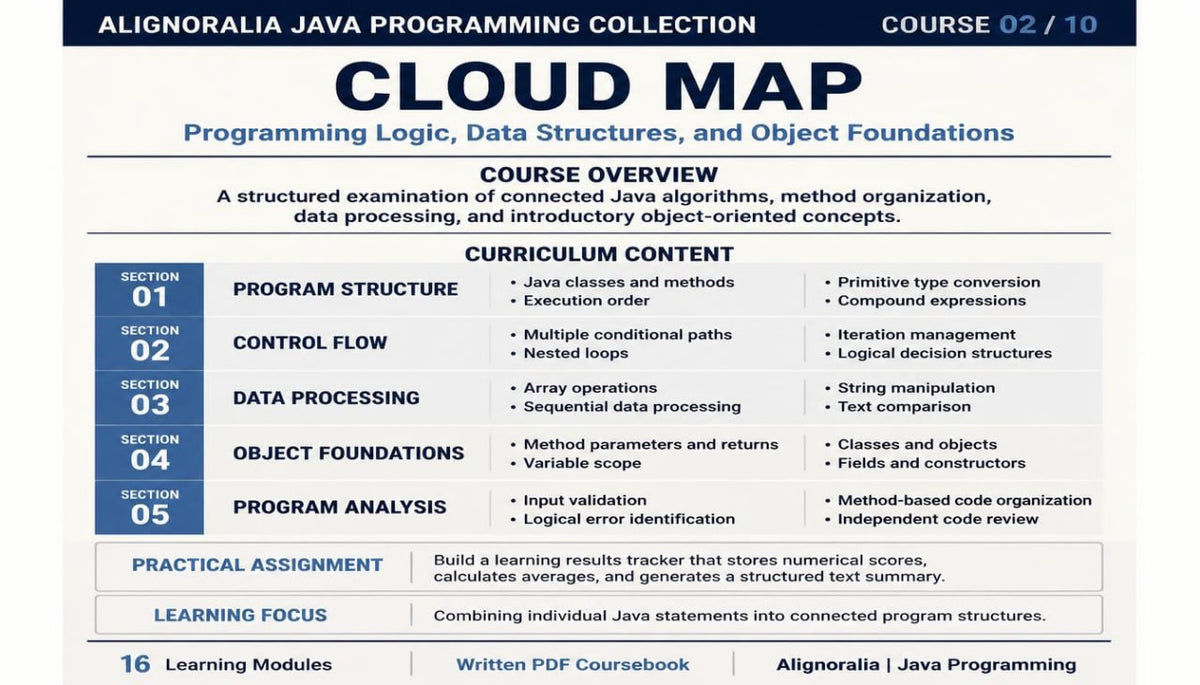
Module 1: Mapping Java Program Structure
Explore the relationships between classes, methods, statements, and the execution order of programming instructions.
Module 2: Data Types and Value Conversion
Examine primitive data types, numeric conversions, and type compatibility rules.
Module 3: Extended Operator Usage
Study logical, arithmetic, and comparison operators within compound expressions.
Module 4: Conditions and Multiple Decision Paths
Learn how conditional structures represent different program execution scenarios.
Module 5: Loops and Iteration Control
Explore nested loops, counters, termination conditions, and iteration management.
Module 6: Arrays and Sequential Data Processing
Examine array creation, element retrieval, and calculations performed on collections of values.
Module 7: Strings and Text Operations
Study text comparison, character searching, and fundamental string-processing methods.
Module 8: Methods as Logical Building Blocks
Learn how to define methods with parameters and use their returned values.
Module 9: Variable Scope
Explore local variables, method parameters, and rules governing value usage across code sections.
Module 10: Introduction to Classes and Objects
Examine the purpose of classes, object creation, and relationships between data and methods.
Module 11: Fields and Constructors
Learn how to describe object state and assign initial values during object creation.
Module 12: Data Validation and Logical Checks
Study how to validate values before calculations and handle predictable invalid data.
Module 13: Identifying and Explaining Errors
Examine common logical errors and techniques for reviewing intermediate calculation results.
Module 14: Organizing a Small Program
Explore responsibility distribution between methods, repeated code reduction, and calculation sequences.
Module 15: Practical Assignment — Learning Results Tracker
Create an educational algorithm that stores scores, calculates average values, and generates a text summary.
Module 16: Final Knowledge Review
Review the main topics through exercises involving reading, completing, and analyzing Java code.
4. Who Is This For?
✅ This course is suitable if you:
- Already understand fundamental Java syntax and want to continue studying.
- Are familiar with variables, loops, and conditional statements.
- Want to examine the organization of programming algorithms in greater detail.
- Are interested in arrays, string values, and methods.
- Would like an introduction to classes and objects through small examples.
- Prefer structured written explanations.
- Plan to complete practical exercises independently.
- Want to learn how to divide programming tasks into logical sections.
❌ This course may not suit you if you:
- Have not yet studied variables, conditions, or loops and need an introduction from the beginning.
- Are looking for detailed coverage of complex application architecture.
- Need advanced materials about concurrent programming.
- Expect extensive analysis of large programming projects.
- Prefer individual instructor-led sessions instead of written course materials.
5. What You'll Learn
The course covers specific concepts and practical activities related to the fundamental structure of Java programs.
- Program Organization: Understanding relationships between classes, methods, and statements.
- Data Types: Working with primitive types and examining value conversions.
- Compound Logical Conditions: Constructing expressions containing multiple checks.
- Loop Control: Working with nested iterations and defining termination conditions.
- Array Processing: Iterating through values, searching for elements, and performing basic calculations.
- String Operations: Comparing text values, locating characters, and constructing new strings.
- Method Definition: Defining parameters, passing arguments, and returning calculation results.
- Variable Scope: Understanding the rules governing local variable usage.
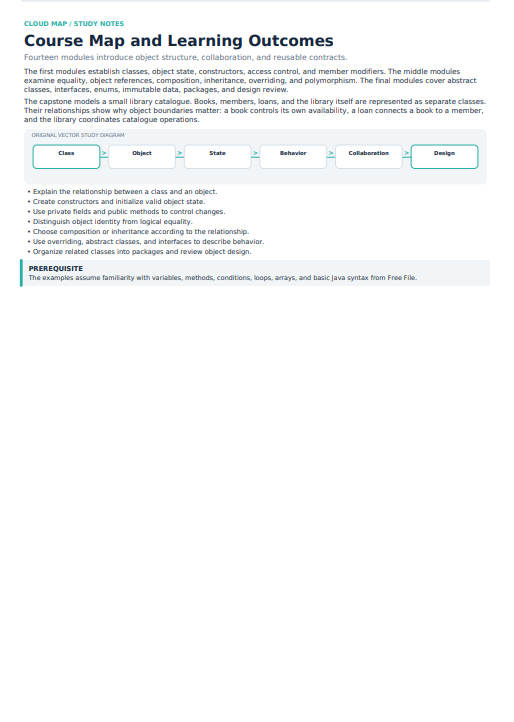
- Fundamental Classes: Describing object properties and behavior.
- Constructors: Initializing objects for subsequent operations.
- Value Validation: Examining input data before performing calculations.
- Algorithm Organization: Dividing longer procedures into separate logical components.
- Error Analysis: Identifying incorrect conditions, values, and execution sequences.
- Practical Programming: Constructing a small educational program for numeric data processing.
- Code Reading: Explaining the purpose of methods and the sequence of program operations.
6. Refund Terms
Cloud Map has a 14-day refund period, subject to the published refund policy of the Alignoralia store. Before placing an order, we recommend reviewing the terms governing refunds for digital educational materials, the procedure for submitting requests, and the additional provisions of the store's refund policy.
7. Certificates & Credentials
Upon completing Cloud Map, learners receive an Alignoralia PDF certificate documenting their study of object-oriented Java programming.
Do I need previous programming experience to study Alignoralia courses?
Do I need previous programming experience to study Alignoralia courses?
The Alignoralia collection covers different stages of learning Java. Introductory materials explain fundamental syntax and programming principles, while subsequent courses explore more detailed technical topics. Before choosing a course, we recommend reviewing its description, module outline, and practical exercises.
What format do the learning materials use?
What format do the learning materials use?
Alignoralia courses are presented as written PDF coursebooks. The materials contain topic-based sections, explanations of programming structures, code examples, and exercises for independent study. This format allows learners to revisit specific subjects during their studies.
Can I study the materials at my own pace?
Can I study the materials at my own pace?
Yes. The written format allows you to organize your own study sessions, review explanations, and spend additional time on individual exercises when needed. You can plan your studies around your schedule and previous knowledge.
Share