Alignoralia
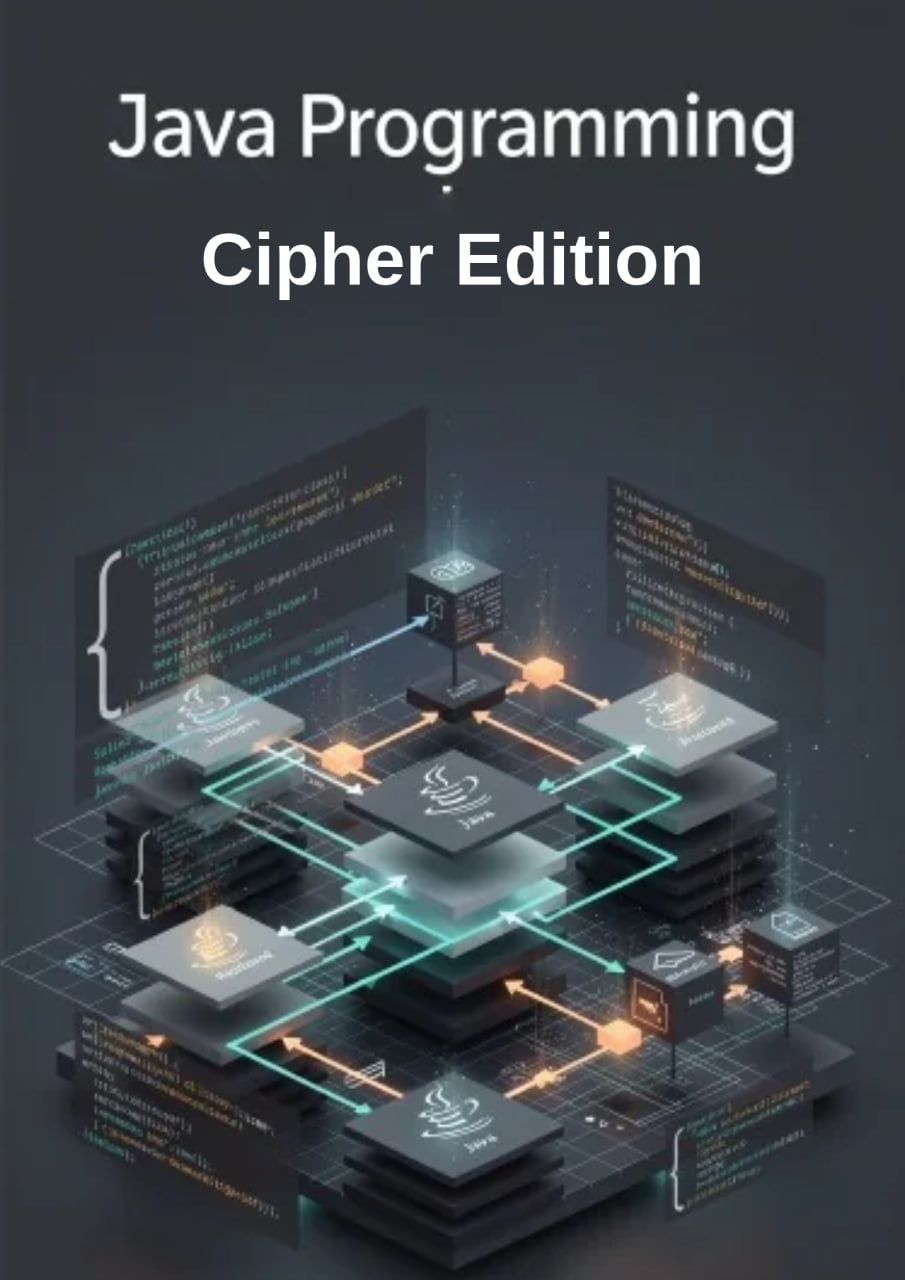
Cipher Edition
Cipher Edition
Couldn't load pickup availability
- 📩 Digital file available after purchase
- 📚 Long-term availability
- 🔒 Secure checkout
- 🗓️ Content updated in 2026
Self-paced learning overview
1. Problem Statement — When Programming Logic Meets Unpredictable Data
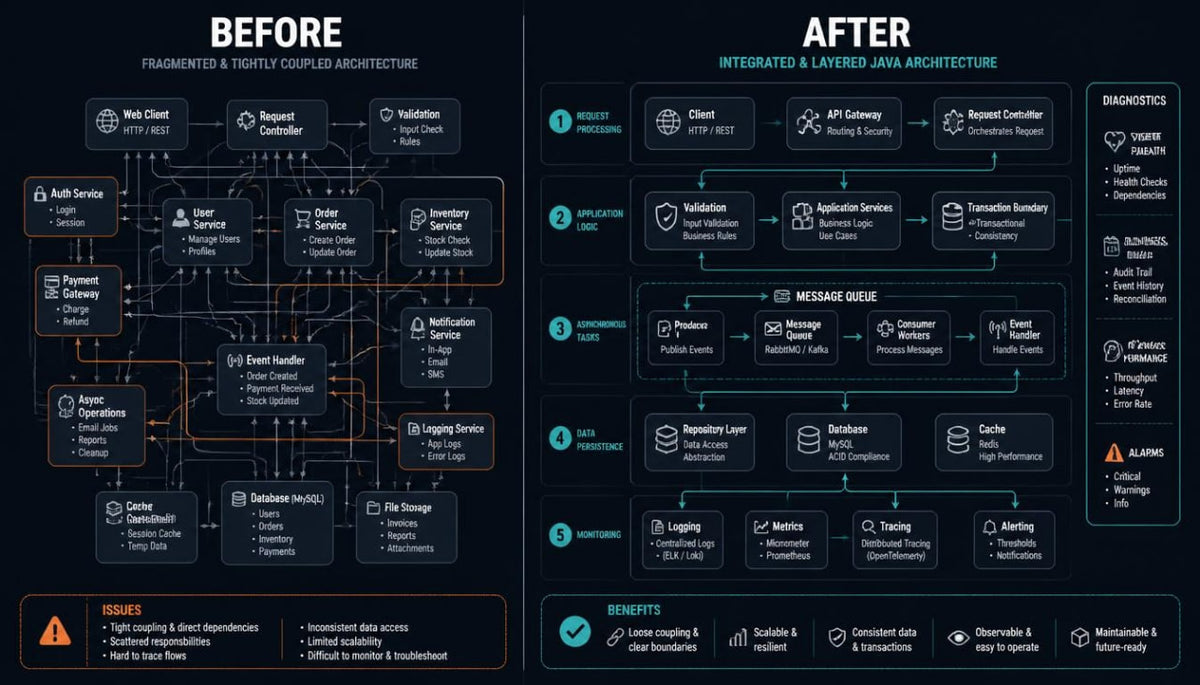
After studying network communication and database operations, learners encounter the need to pay greater attention to information protection and operation validation in Java applications. Data received from external sources may contain invalid values, unexpected characters, or structures that do not match the anticipated format. Insufficient separation of permissions between components can introduce unwanted scenarios involving information retrieval or modification. Additional challenges arise when managing credentials, handling exceptions, storing sensitive information, and recovering from operational errors. Studying these challenges requires an understanding of defensive programming, risk assessment, and controlled interactions between application components.
2. Solution — Defensive Mechanisms as Part of Application Architecture
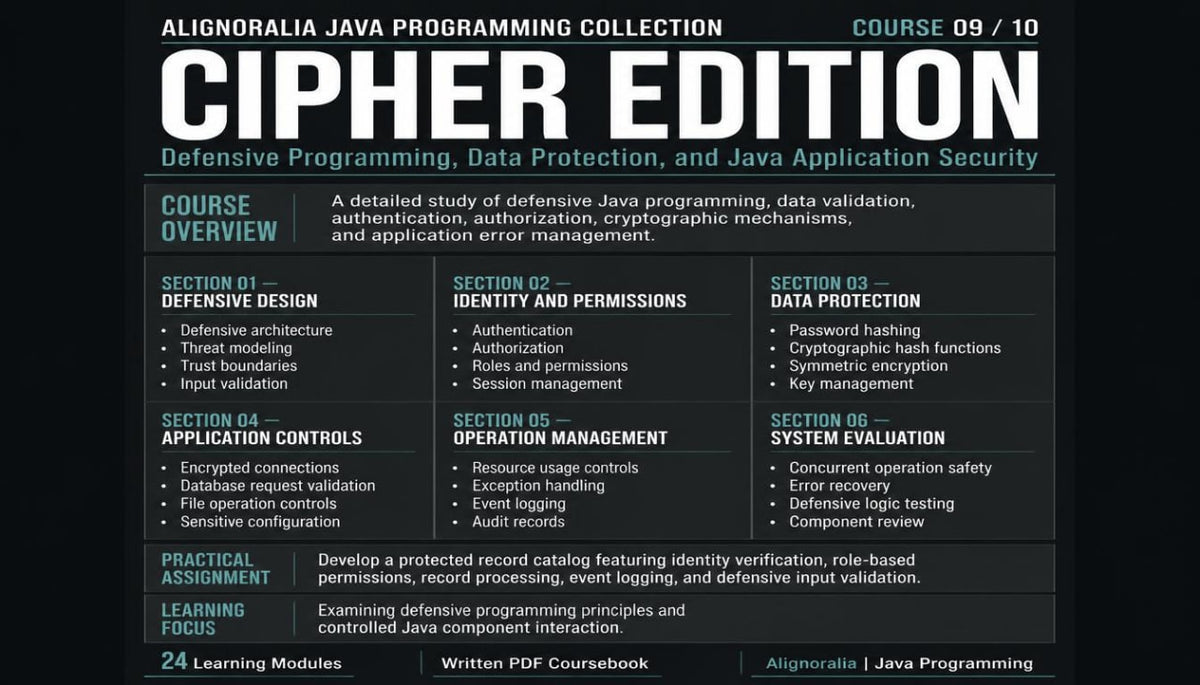
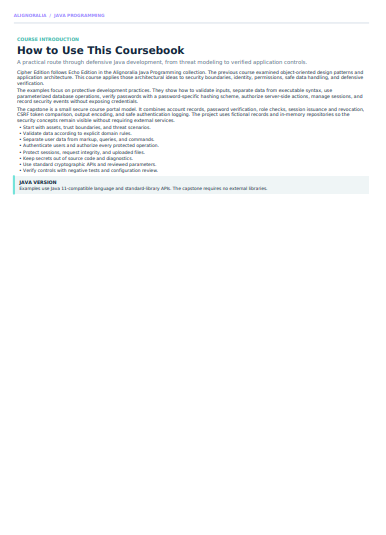
Cipher Edition provides a structured examination of approaches to building Java applications with clearly defined data validation and operation management rules. The learning modules cover authentication, authorization, sensitive information protection, and cryptographic mechanisms. Separate sections explain request validation, file operation controls, defensive database interactions, and event recording. Practical exercises encourage learners to examine invalid inputs, analyze component responsibilities, and evaluate application behavior during errors. The concluding educational project combines request processing, permission management, information storage, and event diagnostics within a structured Java application.
3. What's Inside — Course Modules
Module 1: Defensive Programming Architecture
Explore principles for creating Java components with defined rules for processing data and requests.
Module 2: Threat Modeling
Examine approaches to identifying important data, trust boundaries, and unwanted execution scenarios.
Module 3: Trust Boundaries Between Components
Learn how to identify points where information moves between application components with different permissions.
Module 4: Input Data Validation
Explore checks for formats, value ranges, and required fields before request processing.
Module 5: Text Value Processing
Examine rules for validating, normalizing, and representing textual information.
Module 6: User Authentication
Study principles for validating credentials and identifying the party submitting a request.
Module 7: Operation Authorization
Learn how to check permissions before viewing, creating, or modifying records.
Module 8: Roles and Permissions
Explore role models and operation rules for different categories of users.
Module 9: Session Management
Examine the creation, validation, and termination of user sessions.
Module 10: Credential Storage
Study principles for using specialized password-hashing algorithms when storing credentials.
Module 11: Cryptographic Hash Functions
Explore hashing and its role in checking information integrity.
Module 12: Application Data Encryption
Examine fundamental symmetric encryption principles and cryptographic key management.
Module 13: Encrypted Network Connections
Study TLS principles and remote endpoint verification during data transmission.
Module 14: Database Request Validation
Learn how to use parameterized queries and restrict operations according to application rules.
Module 15: Defensive File Operations
Explore file path validation, filename checks, and permitted reading and writing operations.
Module 16: Sensitive Configuration Management
Examine approaches to separating service parameters and sensitive values from application source code.
Module 17: Resource Usage Controls
Learn how to define boundaries for request processing, data volumes, and operation duration.
Module 18: Exception Handling Without Internal Detail Exposure
Explore error message design that avoids revealing internal technical information to users.
Module 19: Event Logging and Auditing
Examine recording important operations and maintaining logs for subsequent application analysis.
Module 20: Concurrent Operation Safety
Explore shared-state management and permission checks during concurrent task execution.
Module 21: Recovery After Operational Errors
Learn how to organize controlled operation termination, resource cleanup, and retry handling for eligible requests.
Module 22: Testing Defensive Logic
Examine test scenarios involving invalid data, rejected operations, and unexpected application states.
Module 23: Practical Project — Protected Record Catalog
Create an educational Java application with user verification, permission separation, record processing, and event logging.
Module 24: Final Architecture Review
Combine data validation, cryptographic mechanisms, authorization, and error handling in an integrated educational assignment.
4. Who Is This For?
✅ This course is suitable if you:
- Already have experience with Java and object-oriented programming.
- Understand client-server communication principles.
- Are familiar with databases and information persistence.
- Want to examine defensive programming principles.
- Are interested in user verification and permission management.
- Would like to study fundamental cryptographic mechanisms.
- Want to explore defensive file and network operations.
- Plan to examine invalid request handling.
- Are interested in event auditing and diagnostics.
- Prefer written educational materials with technical examples.
- Want to create educational applications with separate defensive components.
❌ This course may not suit you if you:
- Are just beginning to study Java.
- Have not yet studied classes, interfaces, and collections.
- Lack fundamental knowledge of network communication.
- Need introductory programming materials.
- Are looking for a course about network equipment administration.
- Expect offensive techniques for investigating third-party systems.
- Prefer individual instructor-led sessions.
- Are looking for a ready-made application instead of educational examples.
5. What You'll Learn
- Defensive Java architecture.
- Threat modeling.
- Input data validation.
- Authentication and authorization.
- Role and session management.
- Hashing and encryption.
- Encrypted network connections.
- Database operation validation.
- Defensive file handling.
- Event logging and auditing.
- Error handling.
- Defensive logic testing.
6. Refund Terms
Cipher Edition has a 14-day refund period, subject to the published refund policy of the Alignoralia store.
Before placing an order, we recommend reviewing the conditions governing refunds for digital educational materials, the request submission procedure, and the provisions concerning files already received.
7. Certificates & Credentials
Upon completing Cipher Edition, learners receive an Alignoralia PDF certificate documenting their study of Java application security and secure coding.
Do I need previous programming experience to study Alignoralia courses?
Do I need previous programming experience to study Alignoralia courses?
The Alignoralia collection covers different stages of learning Java. Introductory materials explain fundamental syntax and programming principles, while subsequent courses explore more detailed technical topics. Before choosing a course, we recommend reviewing its description, module outline, and practical exercises.
What format do the learning materials use?
What format do the learning materials use?
Alignoralia courses are presented as written PDF coursebooks. The materials contain topic-based sections, explanations of programming structures, code examples, and exercises for independent study. This format allows learners to revisit specific subjects during their studies.
Can I study the materials at my own pace?
Can I study the materials at my own pace?
Yes. The written format allows you to organize your own study sessions, review explanations, and spend additional time on individual exercises when needed. You can plan your studies around your schedule and previous knowledge.
Share