Alignoralia
Arc Module
Arc Module
Couldn't load pickup availability
- 📩 Digital file available after purchase
- 📚 Long-term availability
- 🔒 Secure checkout
- 🗓️ Content updated in 2026
Self-paced learning overview
1. Problem Statement — When Applications Need a Connected Architecture
After studying classes, collections, and functional Java structures, learners encounter the need to combine these mechanisms into larger programming models. As the number of components increases, defining their responsibilities and managing interactions becomes more challenging. Poorly organized programming logic can lead to repeated code, unnecessary dependencies, and difficulties when modifying existing structures. Input validation, exception handling, information storage, and component testing also require careful consideration. Further Java study involves examining modular organization and building applications with clearly defined responsibilities.
2. Solution — Giving Every Component a Defined Purpose
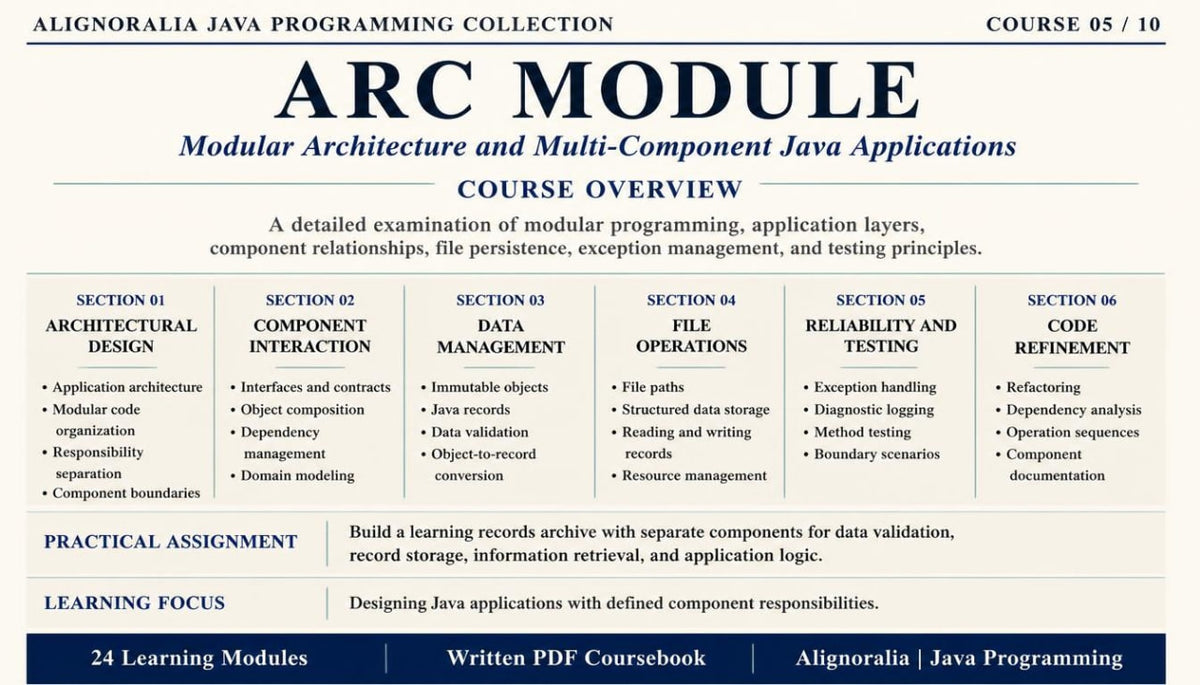
Arc Module provides a step-by-step examination of architectural approaches to creating Java applications composed of interconnected components. The materials explain responsibility distribution between classes, interface usage, and interactions across separate application layers. Individual sections cover data validation, file structures, exception management, and testing programming logic. Practical exercises encourage learners to examine dependencies, modify class structures, and compare approaches to code organization. The concluding assignment combines these topics into an application model with separate components for information storage, processing, and presentation.
3. What's Inside — Course Modules
Module 1: Java Application Architecture
Explore principles for organizing application components and defining their functional responsibilities.
Module 2: Modular Thinking and Code Structure
Examine how programming logic can be divided into separate classes and groups of related components.
Module 3: Single Responsibility Principle
Learn how to identify individual class responsibilities and separate unrelated functions.
Module 4: Interfaces and Component Boundaries
Explore interfaces used to describe interactions between different application components.
Module 5: Composition and Dependency Management
Examine constructor-based dependency injection and the creation of interconnected objects.
Module 6: Domain Modeling
Learn how to represent domain entities through classes, fields, methods, and behavioral rules.
Module 7: Immutable Objects and Records
Explore immutable structures and Java records for representing data.
Module 8: Input Value Processing
Examine validation of text, numeric, and other values before executing programming operations.
Module 9: Creating a Separate Logic Layer
Explore classes responsible for calculations and the coordination of operation sequences.
Module 10: Information Storage Components
Learn how to separate data storage operations from core application logic.
Module 11: Working with File Paths
Study Path and Files for locating and processing files.
Module 12: Reading and Writing Structured Data
Examine storing text records and reconstructing information from file sources.
Module 13: Converting Between Data Structures
Learn how to convert text records into Java objects and create textual representations of objects.
Module 14: Advanced Exception Handling
Explore exception hierarchies and the communication of error information between methods.
Module 15: Resource Management
Examine file resource management and mechanisms for closing resources after operations.
Module 16: Organizing Diagnostic Messages
Explore principles for recording application events, errors, and important execution stages.
Module 17: Fundamentals of Java Code Testing
Learn how to create individual method checks and compare actual results with expected values.
Module 18: Test Scenarios and Boundary Values
Examine empty datasets, invalid values, and unusual execution conditions.
Module 19: Component Refactoring
Explore techniques for reducing repetition, renaming elements, and reorganizing code while preserving intended behavior.
Module 20: Designing Operation Sequences
Learn how to describe component interactions during multi-stage programming tasks.
Module 21: Processing Large Record Collections
Examine sequential reading, filtering, and grouping information from file sources.
Module 22: Practical Project — Learning Records Archive
Create an educational application for storing, searching, validating, and organizing records through separate components.
Module 23: Project Structure Analysis
Examine class dependencies, responsibility distribution, and file operation organization.
Module 24: Final Practical Assignment
Combine data modeling, interfaces, validation, file operations, and test scenarios in an integrated educational assignment.
4. Who Is This For?
✅ This course is suitable if you:
- Already understand object-oriented Java principles.
- Are familiar with classes, interfaces, and collections.
- Have experience creating small Java applications.
- Want to examine component organization in greater detail.
- Are interested in modular design principles.
- Would like to study approaches to reducing class dependencies.
- Want to work with file structures.
- Plan to explore data validation and application logic testing.
- Prefer written learning materials supported by code examples.
- Want to create educational projects involving several connected components.
❌ This course may not suit you if you:
- Are just beginning to study Java.
- Have not yet studied classes, methods, or interfaces.
- Need introductory explanations of fundamental syntax.
- Are looking solely for advanced concurrent system topics.
- Expect detailed coverage of network infrastructure.
- Prefer individual instructor-led sessions.
- Are looking for ready-made commercial applications rather than educational examples.
5. What You'll Learn
- Java application architecture.
- Modular code organization.
- Interfaces and dependencies.
- Class and object modeling.
- Data validation and conversion.
- File operations.
- Exception handling.
- Testing fundamentals.
- Code refactoring.
- Multi-component application design.
6. Refund Terms
Arc Module has a 14-day refund period, subject to the published refund policy of the Alignoralia store.
Before placing an order, we recommend reviewing the conditions governing refunds for digital educational materials, the request submission procedure, and the provisions concerning files already received.
7. Certificates & Credentials
Upon completing Arc Module, learners receive an Alignoralia PDF certificate documenting their study of Java design patterns.
Do I need previous programming experience to study Alignoralia courses?
Do I need previous programming experience to study Alignoralia courses?
The Alignoralia collection covers different stages of learning Java. Introductory materials explain fundamental syntax and programming principles, while subsequent courses explore more detailed technical topics. Before choosing a course, we recommend reviewing its description, module outline, and practical exercises.
What format do the learning materials use?
What format do the learning materials use?
Alignoralia courses are presented as written PDF coursebooks. The materials contain topic-based sections, explanations of programming structures, code examples, and exercises for independent study. This format allows learners to revisit specific subjects during their studies.
Can I study the materials at my own pace?
Can I study the materials at my own pace?
Yes. The written format allows you to organize your own study sessions, review explanations, and spend additional time on individual exercises when needed. You can plan your studies around your schedule and previous knowledge.
Share